What you'll need:
3 fabrics - 2 outer fabrics (or one if you prefer) and 1 fabric for lining.
Interfacing (if your fabric is lightweight)
8x 6-9mm rivets
Magnetic clasp (optional)
Basic sewing supplies (sewing machine, scissors, tailors awl, hammer, iron and ironing board, etc)
Cutting:
Lining and interfacing- 43cm x 86cm each
Handles- 2x 8cm x 60cm
Lower outer strip- 43cm x 45cm (if you only have one outer fabric, cut 1 piece of 43cm x 89cm)
Upper outer strip- 2x 43cm x 22cm (you don't need this if you are using only 1 outer fabric)

1. Piece the outer section:
(Skip this part if you are using 1 outer fabric)
Place one upper strip rights sides together with the lower outer strip, matching the raw edges on the 43cm side. Sew them together with a 1cm seam allowance. Repeat on the other side of the lower outer strip so the 3 pieces are sewn together to make one long strip.
Press the seam allowances towards the upper strips. Topstitch on the right side of the fabric approx. 2mm away from the seamline (on the upper strip so you are sewing through the seam allowance). Repeat for the other seam.
Place the rough side of the interfacing (if you are using it) onto the back of the section you have just finished. It should be positioned in the middle, won't reach the edges of the fabric. This is to reduce bulk.
2. Sew the side seams:
Fold the outer section in half, right sides together, so the seams where the upper and lower sections join are matching at both sides. Pin. Sew along both sides, leaving a 1cm seam allowance. The other 2 sides should be a folded edge and an open edge for the top of the bag.
Repeat this step for the lining, but leave an additional 6cm gap in one of the side seams. Make sure the gap is in the middle of the side and not too close to the top edge or bottom corner. This gap is to turn the bag through to the right side later.

3. Square off the corners:
To flatten the base of the bag, you need to square off the 4 corners. First take one corner of the outer bag, and make a triangle with the side seam and bottom fold in the center. Measure 7cm from the tip of the triangle and draw a line across. Pin and sew across the line. Repeat for the remaining 3 corners.
4. Add a clasp (optional):
If the want to add a clasp (the one I've used is a no-sew magnetic clasp) do so now. Measure 3cm down from the top edge of the outer bag and follow the instructions on the packet to add your clasp.
5. Prepare the handles:
Fold in the 4 raw edges by approx. 0.5cm to the wrong side. Press and pin if necessary. Then fold in half (wrong sides together), lengthways, press and pin. Topstitch along both long edges approx. 2mm from the edge. Secure the threads at both sides. Repeat for the other handle. Keep aside for later.
6. Sew the bags together:
Turn the lining bag, right side out. Keep the outer bag inside out. Insert the lining into the outer bag so the top raw edges are even, the side seams are matching and the right sides of the fabrics are together. Pin. Remove the arm from your sewing machine and fit the top opening of the bag either side of the machine so you can sew all the way around the top. Leave a 1cm seam allowance.
7. Turn to the right side:
Once you have sewn around the top edge of the bag, pull the lining out and turn the bag to the right side through the hole. Poke out all the corners before sewing the hole shut. When sewing the hole, push the seam allowance to the inside, and stitch very close to the edge, securing the stitching at both ends of the gap. Push the lining to the inside.
8. Topstitch:
Top stitching secures the lining into place and creates a clean upper edge. For this bag, the lining is slightly shorter than the outer bag, so push the lining down so the bases meet. This should bring the outer fabric (and your clasp if you have one) to the inside by 3cm. This makes sure that you can't see the lining fabric from the outside. Make sure it is even all the way around, pin and put the bag on your machine as you did before. Sew all around the top edge, approx. 2mm from the upper edge. Be careful where the clasps are attached (if the needle hits the clasp it will break).


9. Attach handles:
To attach the handles you will need a fabric marker, ruler, rivets, a tailors awl and a hammer. Lay the bag flat, with the seams at the sides. With your ruler and marker, position your first handle where you want it (approx. 6cm in from the side and 4cm down from the top. Mark. Make sure the handle is not twisted.
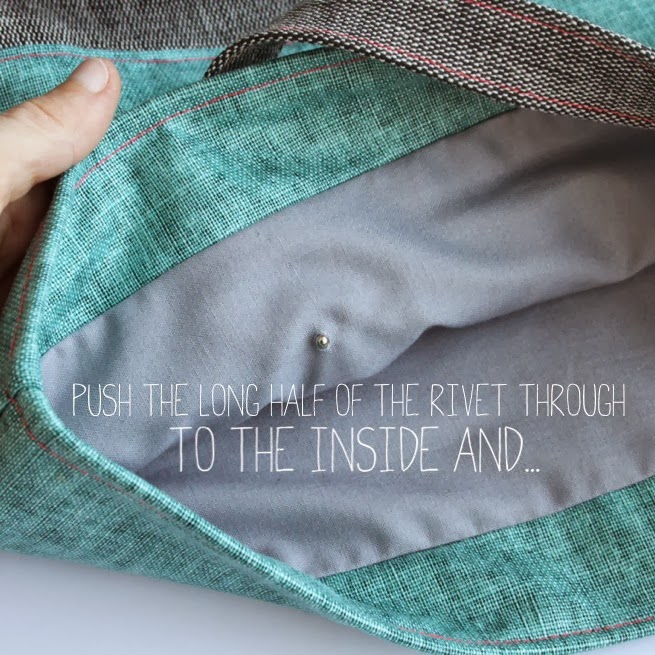
Use the tailors awl to pierce a hole through the handle, outer fabric and lining. You will need to make two holes, close to the bottom edge of the handle, and on both sides (the rivets will only be a couple of mm's apart). Take the long part of the rivet and push it through the hole through to the inside of the bag. Then attach the small part of the rivet in the back to secure. Repeat for the other rivet and make sure the handle is straight. Then take the hammer and lightly hit the rivet until it is tight against the fabric. Repeat for the other end of the handle and on the other side of the bag.
Note: when hammering the rivets, don't hit too hard as the rivets will bend out of shape.
Done!